

How many times have you wished for the chance to stand up tall against injustice in the face of a ruling class that dominates you? Obviously, you wouldn’t win, but you’d at least give them the middle finger. Well, if you had lived in 399 BC, they would also have given you some hemlock to drink on your own afterward, but hopefully by then, you would have cooled off.
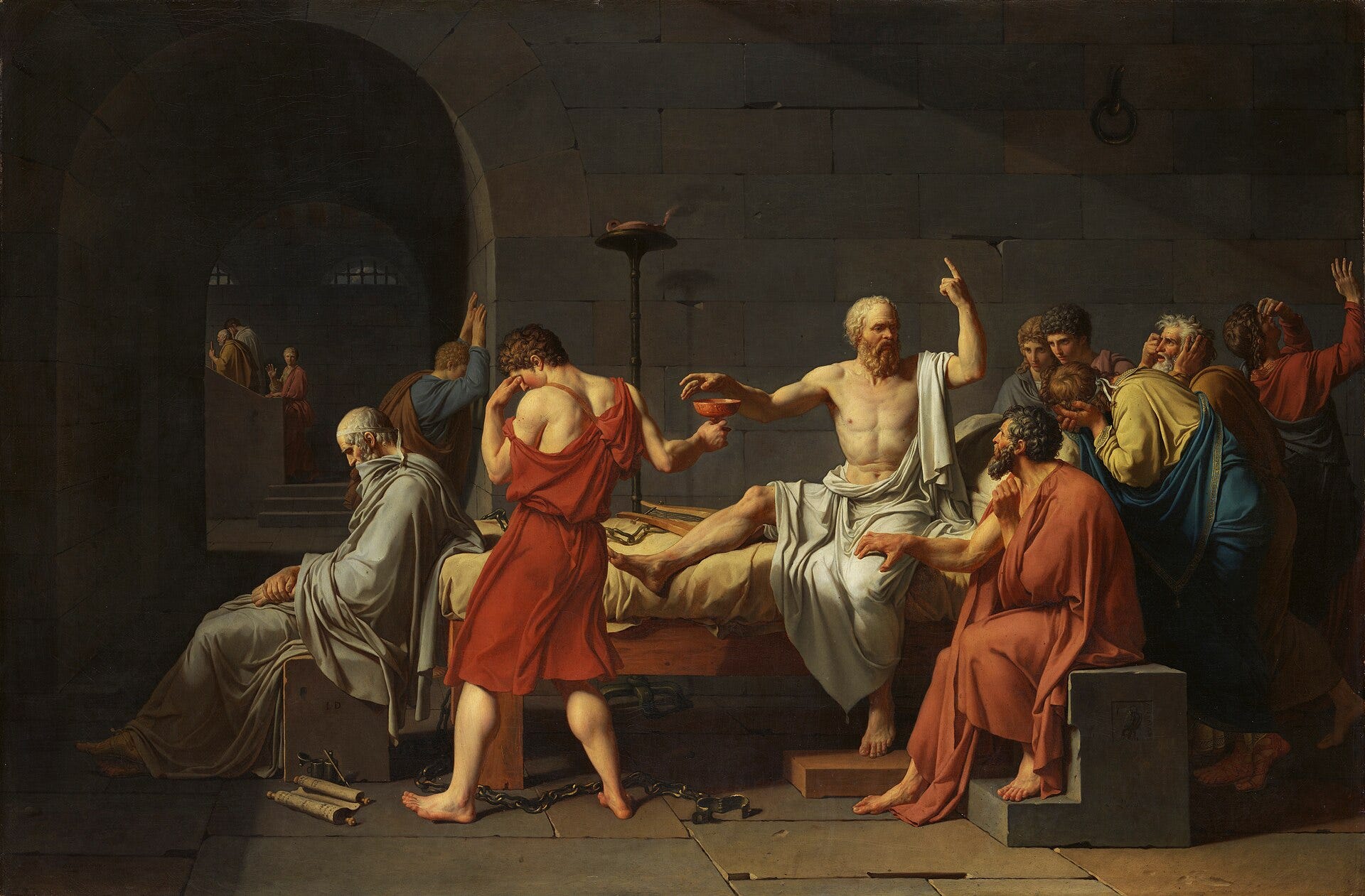
That’s exactly what Socrates did in front of his judges, and he finished them off once and for all.
Let me add the appropriate soundtrack as well.
In 404 BC, the Athenians lost the Peloponnesian War, and for eight months they were ruled by the Thirty Tyrants, imposed upon them by the Spartans after their victory. After democracy was restored, the Athenians searched for a scapegoat to help them relax. And what did they think of? To target someone theoretically weak.
Socrates was a ragged-looking figure who held endless dialogues every day in Athens with the youth of his time. In other words, he didn’t give them lessons; he engaged in conversations. He spent all day trying to inspire young people to care about great values and virtues, not about money and material goods. Hmm, that reminds me of something today.
Thus, the wisest citizen of the city was accused of corrupting the youth and not worshipping the ancestral gods of the time (the Athenians were quite, if not very, religious), but instead introducing new ones. So, he was summoned to make a defense speech in court.
He was found guilty and sentenced to death by hemlock, while he himself counter-proposed as his penalty free meals at the Prytaneum for the rest of his life. This was a distinguished honor reserved for benefactors of the Athenian state. He was given the opportunity to flee, both before and after his trial, but he refused. After all, he was innocent—why should he run?
The most democratic city in history (theoretically) murdered its most worthy citizen. So, even back then, it was not a time for people who think. Today, I wonder: has a comparable Socrates been born, or will one be born? And if so, how would we treat him?
We thus have a striking case where democracy attacks, unable to tolerate criticism. Socrates is guilty of having expanded his mind and taught his discoveries to his students. This was the reason for his execution: the thirst for free thought, the pursuit of knowledge, and the questioning of social establishments.
Yet, the unexamined life is not worth living.
Continue the Journey
Subscribe to receive future issues.
If you’d like to support the work behind Monday Steps, you can buy me a coffee.